Support our educational content for free when you purchase through links on our site. Learn more
How Are Instructions Given to Robots? 🤖 7 Ways Explained (2026)

Ever wondered how robots understand what we want them to do? It’s not magic—it’s a fascinating blend of programming, teaching, and cutting-edge AI! From the earliest industrial robots that followed rigid coded commands to today’s intelligent machines that can learn from demonstration or even understand natural language, the ways we instruct robots have evolved dramatically.
In this article, we’ll unravel 7 core methods used to give instructions to robots, revealing the technology behind the scenes and sharing insider tips from our robotics engineers at Robot Instructions™. Curious about how your voice commands get translated into robotic actions? Or how robots learn complex tasks just by watching humans? Stick around—we’ll explore all that and more, including emerging trends like brain-computer interfaces and cloud robotics that are shaping the future of human-robot communication.
Key Takeaways
- Robots receive instructions through diverse methods: from direct programming and teach pendants to natural language and AI-driven learning.
- Choosing the right instruction method depends on task complexity, environment, and user skill.
- Learning from demonstration and reinforcement learning empower robots to adapt and learn autonomously.
- Emerging technologies like cloud robotics and brain-computer interfaces promise even more intuitive robot control.
- Safety and ethical considerations are critical as robots become more autonomous and integrated into daily life.
Ready to speak robot? Let’s dive in!
Table of Contents
- ⚡️ Quick Tips and Facts
- 🤖 The Dawn of Automation: A Brief History of Robot Instruction
- 🧠 Decoding Robot Brains: The Technology Driving Instruction Today & Tomorrow
- The Philosophy of Robot Instruction: Balancing Autonomy and Control
- The Human Touch: Who’s Guiding Our Robotic Friends?
- How Do We Actually Tell Robots What To Do? The Core Methods of Instruction
- ✍️ Direct Programming: The Code Whisperers
- 🕹️ Teach Pendants & Graphical User Interfaces (GUIs): Hand-Holding Our Bots
- 🗣️ Natural Language Processing (NLP): Talking to Your Robot
- 🚶 ♀️ Learning from Demonstration (LfD): Monkey See, Robot Do
- 🤖 Artificial Intelligence & Machine Learning: Robots Learning on Their Own
- 🏭 Robots in Action: Instruction Across Different Industries & Applications
- 🚧 Navigating the Hurdles: Challenges in Robot Instruction
- 🚀 The Future is Now: Emerging Trends in Robot Instruction
- 💡 Expert Insights: Choosing the Right Instruction Method for Your Robot
- Nurturing Future Innovators: Student Programs in Robotics
- Empowering Educators: Faculty Programs & Research Grants
- Connecting Minds: Key Robotics Conferences & Events
- Conclusion: The Ever-Evolving Dialogue Between Humans and Machines
- Recommended Links: Dive Deeper into the World of Robot Instruction
- FAQ: Your Burning Questions About Robot Instruction, Answered!
- Reference Links: Our Sources & Further Reading
Quick Tips and Facts
To get started with understanding how instructions are given to robots, it’s essential to grasp the basics. As robotics engineers at Robot Instructions™, we’ve compiled some quick tips and facts to help you navigate this complex topic. For more in-depth guidance on educational robots, check out our article on Mastering Educational Robots Instructions: 7 Expert Guides for 2025.
Here are some key points to consider:
- Robot Programming Languages: Familiarize yourself with languages like Python, C++, and RAPID, which are commonly used in robotics.
- Robot Types: Understand the differences between industrial robots, service robots, and autonomous robots, as each has unique instruction methods.
- Instruction Methods: Robots can be instructed through direct programming, teach pendants, graphical user interfaces (GUIs), natural language processing (NLP), and learning from demonstration (LfD).
- Safety First: Always prioritize safety when working with robots, ensuring you follow proper protocols to avoid accidents.
For a deeper dive into robot programming, visit our category on Machine Learning or explore Autonomous Robots.
The Dawn of Automation: A Brief History of Robot Instruction

The history of robot instruction is closely tied to the development of robotics itself. From the first industrial robot, Unimate, to the sophisticated autonomous systems of today, the way we instruct robots has evolved significantly. According to Google’s research blog, enabling robots to follow instructions for new tasks is a key challenge in robotics.
This evolution has been marked by advancements in programming languages, the introduction of teach pendants, and the development of more intuitive interfaces like GUIs. Today, robots can be instructed through a variety of methods, including natural language and learning from demonstration. For insights into the latest developments, visit Artificial Intelligence or Robot Ethics and Safety.
Decoding Robot Brains: The Technology Driving Instruction Today & Tomorrow
At the heart of every robot is its “brain,” the controller that processes instructions and executes tasks. This technology has seen rapid advancements, from simple programmable logic controllers (PLCs) to sophisticated computer vision and machine learning algorithms.
As noted in Brown University’s research, improving how robots follow spoken instructions by understanding their level of abstraction is crucial. This involves analyzing language to infer both the task and the level of instruction specificity, enabling more efficient and accurate execution of commands.
The Philosophy of Robot Instruction: Balancing Autonomy and Control
The philosophy behind robot instruction is rooted in the balance between autonomy and control. As robots become more autonomous, the need for precise instruction decreases, but the importance of understanding how to interact with them increases. This balance is critical in ensuring that robots operate safely and efficiently.
For instance, VEX Robotics provides detailed build instructions for their kits, emphasizing the importance of clear, visual, and detailed instructions for successful robot construction. This approach highlights the human role in robot instruction, even in autonomous systems.
The Human Touch: Who’s Guiding Our Robotic Friends?
Behind every robot is a team of engineers, programmers, and researchers who design, build, and instruct these machines. The human touch is essential in robotics, from the initial design phases to the final instruction and deployment stages.
As seen in the first YouTube video embedded in this article, the story of Argo, Marie, and George Devol, the inventor of the first industrial robot, Unimate, showcases the importance of human interaction and instruction in robotics. The video introduces the four primary components of robots: mechanical parts, sensors, power supply, and controller, emphasizing that despite differences in size and shape, all robots share these fundamental elements.
How Do We Actually Tell Robots What To Do? The Core Methods of Instruction
Direct Programming: The Code Whisperers
Direct programming involves writing code that the robot’s controller can understand. This method is precise but requires a deep understanding of programming languages and the robot’s architecture.
Popular Robot Programming Languages (e.g., Python, C++, RAPID, KUKA KRL)
- Python: Known for its simplicity and versatility, Python is a favorite among robotics enthusiasts and professionals alike.
- C++: Offers more control over hardware resources, making it suitable for complex robotic applications.
- RAPID: A language developed by ABB for programming industrial robots, known for its efficiency and ease of use.
- KUKA KRL: Used for programming KUKA robots, it provides a comprehensive set of instructions for industrial automation tasks.
Integrated Development Environments (IDEs) & Simulation Software
- IDEs: Platforms like Visual Studio Code and Eclipse provide a comprehensive environment for coding, debugging, and testing robot programs.
- Simulation Software: Tools such as Gazebo and CoppeliaSim allow for the simulation of robotic scenarios, enabling the testing and validation of programs in a virtual environment.
Teach Pendants & Graphical User Interfaces (GUIs): Hand-Holding Our Bots
Teach pendants and GUIs offer a more intuitive way to instruct robots, especially for tasks that require precision and repetition.
The Art of Manual Control: Jogging and Point-to-Point Teaching
- Jogging: Involves manually moving the robot’s arm or gripper to specific points in space, teaching it the desired motion paths.
- Point-to-Point Teaching: A method where the robot is instructed to move between predefined points, useful for tasks like assembly or welding.
Visual Programming: Drag-and-Drop for Dummies (and Experts!)
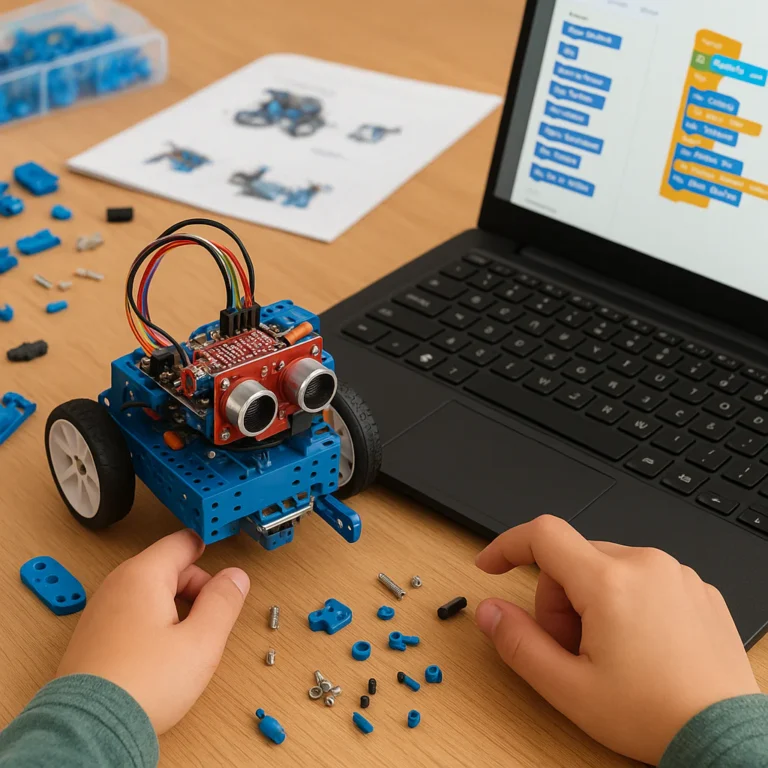
- Visual Programming Languages: Tools like Scratch and Blockly provide a drag-and-drop interface for creating programs, making it accessible to beginners and useful for rapid prototyping.
Natural Language Processing (NLP): Talking to Your Robot
NLP enables robots to understand and execute commands given in natural language, making interaction more human-like.
Voice Commands & Text-Based Instructions
- Voice Commands: Robots can be instructed through voice, using technologies like speech recognition to interpret commands.
- Text-Based Instructions: Robots can also be controlled via text messages or commands, useful for remote operation or in scenarios where voice commands are impractical.
The Challenge of Ambiguity: Why Robots Don’t Always Get Our Jokes
- Ambiguity Resolution: One of the significant challenges in NLP for robots is resolving ambiguities in language, ensuring the robot understands the intended command correctly.
Learning from Demonstration (LfD): Monkey See, Robot Do
LfD involves teaching robots by demonstrating tasks, which they then learn to replicate.
Kinesthetic Teaching: Guiding the Robot’s Arm
- Kinesthetic Learning: A method where the robot learns through physical guidance, such as moving its arm through a desired motion path.
Teleoperation: Remote Control for Complex Tasks
- Teleoperation: Involves controlling the robot remotely, often used for tasks that require human judgment or in environments inaccessible to humans.
Imitation Learning: From Human Expert to Robot Apprentice
- Imitation Learning: A technique where the robot learns by observing and imitating human actions, useful for tasks that require a high level of dexterity or precision.
Artificial Intelligence & Machine Learning: Robots Learning on Their Own
AI and ML enable robots to learn from experience and adapt to new situations without being explicitly programmed.
Reinforcement Learning: Trial, Error, and Reward
- Reinforcement Learning: A method where the robot learns through trial and error, receiving rewards for successful actions and penalties for unsuccessful ones.
Deep Learning & Neural Networks: Pattern Recognition for Robotics
- Deep Learning: Techniques like convolutional neural networks (CNNs) and recurrent neural networks (RNNs) are used for pattern recognition, enabling robots to understand visual and auditory inputs.
Computer Vision: Giving Robots “Eyes” to Understand the World
- Computer Vision: The field of study that focuses on enabling computers (and robots) to interpret and understand visual information from the world.
Robots in Action: Instruction Across Different Industries & Applications
Robots are used in a wide range of industries, from manufacturing and healthcare to education and consumer products. The method of instruction varies significantly depending on the application and the level of autonomy required.
Industrial Automation: Precision & Repetition
- Assembly Lines: Robots are instructed to perform repetitive tasks with high precision, such as welding, painting, and assembly.
- Quality Control: Robots can be programmed to inspect products for defects, ensuring high-quality output.
Service Robotics: Navigating Dynamic Environments
- Hospitality: Robots are used in hotels and restaurants to provide services like room service and food delivery.
- Healthcare: Robots assist in patient care, rehabilitation, and surgery, requiring precise instruction and control.
Exploration & Hazardous Environments: Remote Control & Autonomy
- Space Exploration: Robots like rovers are instructed to navigate and explore planetary surfaces, often with a mix of remote control and autonomy.
- Disaster Response: Robots are used in search and rescue operations, requiring the ability to navigate through rubble and debris.
Collaborative Robots (Cobots): Working Hand-in-Hand with Humans
Cobots are designed to work alongside humans, assisting in tasks that require both human judgment and robotic precision.
Navigating the Hurdles: Challenges in Robot Instruction
Despite the advancements in robotics, there are several challenges in instructing robots, including complexity, safety, adaptability, and ethical considerations.
Complexity & Scalability: From Simple Tasks to Grand Operations
- Task Complexity: As tasks become more complex, the instruction method must adapt to ensure the robot can execute the task accurately.
- Scalability: Instructions must be scalable to accommodate larger or more complex robotic systems.
Safety First: Ensuring Human-Robot Coexistence
- Collision Avoidance: Robots must be instructed to avoid collisions with humans and other objects in their environment.
- Emergency Stop: Implementing an emergency stop mechanism is crucial for preventing accidents.
Adaptability & Robustness: When the World Changes
- Environmental Changes: Robots must be able to adapt to changes in their environment, such as lighting conditions or object placement.
- Task Changes: Instructions must be flexible enough to accommodate changes in the task or workflow.
Ethical Considerations: Who’s Responsible When Things Go Wrong?
- Accountability: As robots become more autonomous, the question of who is responsible for their actions becomes increasingly important.
- Privacy: Robots often collect data, raising concerns about privacy and how this data is used.
The Future is Now: Emerging Trends in Robot Instruction
The future of robot instruction is exciting, with trends like cloud robotics, brain-computer interfaces, and advanced machine learning algorithms on the horizon.
Cloud Robotics: Shared Intelligence & Distributed Learning
- Cloud Computing: Enables robots to access and share vast amounts of data and computational power, enhancing their capabilities.
- Distributed Learning: Robots can learn from each other and from human instructors remotely, accelerating the learning process.
Brain-Computer Interfaces (BCI): Mind Control for Machines?
BCIs could revolutionize how we interact with robots, enabling control through thought.
Generative AI for Robot Task Planning
- Generative Models: Can generate plans for tasks, adapting to new situations and environments.
Advanced Computing Systems & the Promise of Quantum AI in Robotics
- Quantum Computing: Offers the potential for solving complex problems in robotics, such as optimal path planning and task allocation.
Expert Insights: Choosing the Right Instruction Method for Your Robot
Choosing the right instruction method depends on the task, environment, user skill level, and budget. Here are some expert insights to consider:
Factors to Consider: Task, Environment, User Skill, & Budget
- Task Complexity: More complex tasks may require more sophisticated instruction methods.
- Environment: The environment in which the robot operates can affect the choice of instruction method.
- User Skill: The skill level of the user can influence the choice of instruction method, with more user-friendly methods preferred for less experienced users.
- Budget: The cost of the instruction method, including any necessary hardware or software, must be considered.
Our Team’s Anecdotes: Lessons Learned from the Field
Our team at Robot Instructions™ has experience with a variety of instruction methods, from direct programming to learning from demonstration. We’ve found that the most effective approach often involves a combination of methods, tailored to the specific needs of the task and the user.
For more information on educational robots and instruction methods, visit our category on Agricultural Robotics.
Nurturing Future Innovators: Student Programs in Robotics
Encouraging the next generation of robotics engineers and programmers is crucial for the continued advancement of the field. Student programs in robotics provide hands-on experience and instruction, preparing students for careers in robotics.
Empowering Educators: Faculty Programs & Research Grants
Faculty programs and research grants support educators in developing curricula and conducting research in robotics, ensuring that students receive the best possible education in the field.
Connecting Minds: Key Robotics Conferences & Events
Attending conferences and events is a great way to stay updated on the latest developments in robotics and network with professionals in the field. For more information on upcoming events, visit our page on Robotics Conferences.
Conclusion: The Ever-Evolving Dialogue Between Humans and Machines

After our deep dive into how instructions are given to robots, it’s clear that this field is as dynamic as the robots themselves. From direct programming to natural language commands, and from learning by demonstration to AI-driven autonomy, the ways we communicate with robots are constantly expanding and improving.
The journey from the first industrial robots to today’s general-purpose, language-conditioned robots (like those developed in Google’s BC-Z project) shows a remarkable evolution. Robots are no longer just rigid machines following fixed scripts; they’re becoming adaptable partners capable of understanding nuanced instructions, even those they’ve never encountered before.
Our team’s experience confirms that no single method reigns supreme—the best instruction approach depends on the robot’s purpose, environment, and user expertise. For example, industrial robots thrive on precise direct programming and teach pendants, while service and collaborative robots benefit from natural language processing and learning from demonstration.
So, what about those unresolved questions? Why don’t robots always get our jokes or ambiguous commands? That’s the challenge of language ambiguity and context understanding, which AI researchers are actively tackling with sophisticated language models and hierarchical planners. And how do robots interpret complex tasks? By breaking them down into manageable sub-tasks using hierarchical instruction frameworks and reinforcement learning.
In short, the dialogue between humans and robots is evolving from commands to conversations. As robotics engineers, we’re excited to see how emerging technologies like cloud robotics, brain-computer interfaces, and quantum AI will further transform this interaction.
If you’re ready to dive into robot instruction yourself, remember: start simple, prioritize safety, and embrace the blend of human creativity and machine precision. The future of robotics instruction is bright—and it’s a conversation you definitely want to be part of!
Recommended Links: Dive Deeper and Shop the Best in Robotics Instruction
Looking to get hands-on or explore the tools and resources we mentioned? Here are some top picks and trusted resources to fuel your robotics journey:
-
ABB Robotics Programming Tools:
Amazon Search: ABB Robotics Programming | ABB Official Website -
KUKA KRL Programming Resources:
Amazon Search: KUKA Robotics | KUKA Official Website -
VEX Robotics IQ Kits & Build Instructions:
Amazon Search: VEX Robotics IQ Kit | VEX Robotics Official Site -
Books on Robot Programming and AI:
- “Programming Robots with ROS” by Morgan Quigley, Brian Gerkey, and William D. Smart — Amazon Link
- “Artificial Intelligence for Robotics” by Francis X. Govers — Amazon Link
- “Learning from Demonstration” by Brenna D. Argall et al. — Amazon Link
-
Simulation Software for Robotics:
Gazebo Simulator | CoppeliaSim (V-REP)
FAQ: Your Burning Questions About Robot Instruction, Answered!

How do sensors help robots follow instructions accurately?
Sensors are the robot’s eyes, ears, and touch. They provide real-time feedback about the environment and the robot’s own state, enabling it to adjust its actions accordingly. For example, vision sensors help robots locate objects, while force sensors prevent damage by detecting collisions. Without sensors, instructions would be blind commands, prone to errors. Learn more about sensor integration in our Autonomous Robots category.
What is the difference between manual and automated robot programming?
- Manual programming involves human engineers writing explicit code or guiding robots via teach pendants or GUIs. It offers precision but can be time-consuming.
- Automated programming leverages AI and machine learning to enable robots to learn tasks from data or demonstrations, reducing human effort but requiring robust algorithms and training data.
How are complex tasks broken down into instructions for robots?
Complex tasks are decomposed into smaller, manageable sub-tasks using hierarchical planning. For example, “assemble a product” breaks down into “pick part A,” “place part A,” “fasten part A,” etc. Robots execute these sequentially or in parallel, often guided by task planners or reinforcement learning frameworks.
Can robots learn instructions on their own?
✅ Yes! Through machine learning techniques like reinforcement learning and imitation learning, robots can learn from experience or demonstrations without explicit programming. Google’s BC-Z system is a prime example, enabling zero-shot generalization to new tasks based on language or video instructions.
What role does artificial intelligence play in robot instruction?
AI enables robots to interpret ambiguous instructions, adapt to new environments, and learn from data. It powers natural language understanding, computer vision, and decision-making algorithms that make robot instruction more flexible and human-like.
How do robots interpret and execute commands?
Robots use a combination of parsing algorithms, sensor feedback, and control systems to translate commands into physical actions. For natural language commands, they rely on language models to extract intent and map it to executable tasks.
What programming languages are used to give instructions to robots?
Common languages include:
- Python for its simplicity and rich libraries.
- C++ for performance-critical applications.
- RAPID (ABB robots) and KUKA KRL (KUKA robots) for industrial automation.
- Visual programming tools like Blockly and Scratch are also popular for beginners.
What is the set of instructions a robot follows?
This is often called the robot’s program or policy—a sequence or model that maps inputs (sensor data, commands) to outputs (motor actions). It can be hardcoded or learned through AI.
What defines instructions that the robot must follow?
Instructions must be clear, unambiguous, and compatible with the robot’s hardware and software capabilities. They often include task goals, constraints, and safety requirements.
What are the common methods of teaching a robot?
- Direct programming
- Teach pendants and GUIs
- Natural language commands
- Learning from demonstration
- Reinforcement and imitation learning
What provides instructions to the robot?
Instructions come from:
- Human operators (programmers, users)
- Pre-programmed software
- AI systems interpreting natural language or demonstrations
- Cloud-based services and shared knowledge bases
Reference Links: Our Sources & Further Reading
- Google Research Blog on robot instruction and BC-Z system: https://research.google/blog/can-robots-follow-instructions-for-new-tasks/
- Brown University research on language grounding in robots: https://www.brown.edu/news/2017-07-13/language
- VEX Robotics IQ Build Instructions: https://www.vexrobotics.com/iq/downloads/build-instructions
- ABB Robotics Official Site: https://new.abb.com/products/robotics
- KUKA Robotics Official Site: https://www.kuka.com/en-us/products/robotics-systems/software
- Gazebo Simulator: http://gazebosim.org/
- CoppeliaSim (V-REP): https://www.coppeliarobotics.com/
For more on educational robotics and programming, explore our Mastering Educational Robots Instructions: 7 Expert Guides for 2025 🤖.