Support our educational content for free when you purchase through links on our site. Learn more
Robot Technician: What the Job Really Takes 🤖

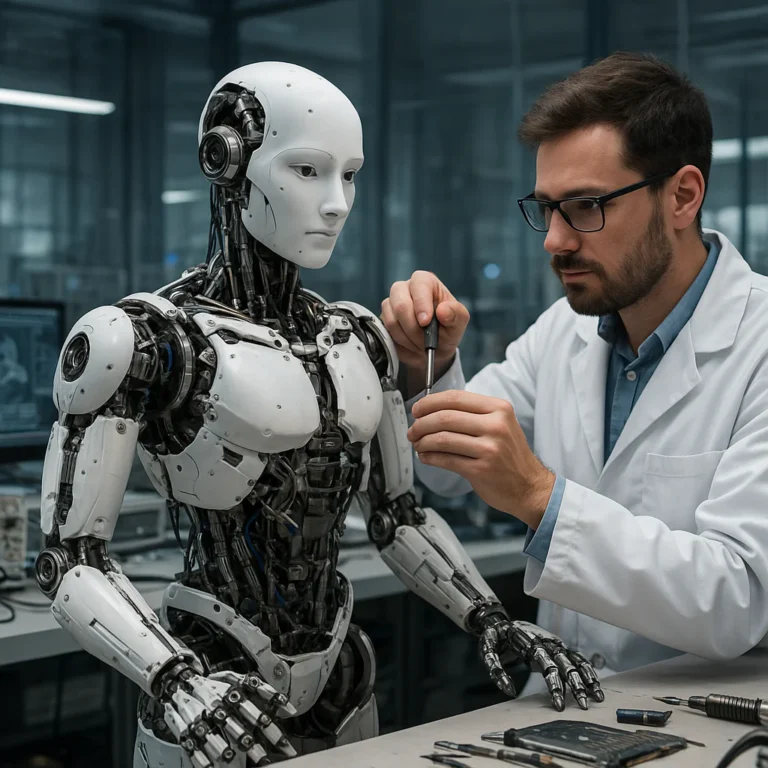
A robot technician installs, maintains, and troubleshots robotic equipment, combining mechanical, electrical, controls, and safety skills. If you enjoy figuring out why a machine stopped—and proving it’s safe before it starts again—this can be a practical path into robotics without necessarily needing a four-year engineering degree.
Here’s the twist: a robot that won’t move may not have a robot problem at all. A blocked sensor, open safety gate, or missing PLC signal can bring the whole cell to a halt, so skilled technicians trace the evidence across the system instead of guessing at the most expensive part.
We’ll explain what robot technicians do, which skills and training employers look for, where the jobs are, and how to get started. You’ll also find ways to compare certificates and programs, prepare for interviews, and choose a career path that fits your goals.
Key Takeaways
- Robot technicians keep automated systems working: They install, operate, maintain, troubleshoot, and test robots and related equipment.
- The role is broader than robot programming: Electrical troubleshooting, mechanical systems, PLCs, sensors, documentation, and safety all matter.
- Several training routes can lead to the field: Certificates, associate degrees, apprenticeships, military technical experience, and related maintenance work are common options.
- Hands-on practice is essential: Look for training that includes real robot, PLC, sensor, and troubleshooting experience.
- Job titles and duties vary: Search for robotics, automation, controls, mechatronics, and industrial maintenance technician roles.
- Safety comes first: Follow site procedures and never bypass a guard or safety device to get a machine running.
Table of Contents
- ⚡️ Quick Tips and Facts
- 🤖 What Does a Robot Technician Do?
- Robot Technician vs. Robotics Engineer vs. Controls Technician
- A Day in the Life of a Robotics Technician
- 🏭 Robotics Technician Background: How the Role Evolved
- 🛠️ Robot Technician Duties and Responsibilities
- Industrial Robot Installation and Commissioning
- Troubleshooting, Repair, and Preventive Maintenance
- Robot Programming, Teach Pendants, and Controls
- Safety Systems and Risk Assessment
- 🏢 Where Robot Technicians Work
- Industries That Hire Robotics Technicians
- Common Robots, Automation Systems, and Tools
- 🧠 Robot Technician Skills Employers Look For
- Electrical, Mechanical, and Mechatronics Skills
- PLC, Sensors, and Industrial Controls
- Programming, Documentation, and Communication
- 🎓 How to Become a Robot Technician
- High School Preparation and Foundational Skills
- Certificates, Trade Schools, and Associate Degrees
- Aprenticeships, Internships, and Entry-Level Experience
- Choosing a Robotics and Automation Training Program
- Hands-On Training and Industry-Driven Curriculum
- Full-Time, Part-Time, and Online Learning Options
- Financial Aid and Training Support
- 📜 Robot Technician Certifications and Credentials
- Industrial Robotics and Automation Certifications
- PLC, Electrical, and Safety Credentials
- How to Choose the Right Certification
- 💼 Robot Technician Career Paths and Specializations
- Industrial Robot and Manufacturing Technician
- Field Service and Robotics Integration Technician
- Collaborative Robots, Mobile Robots, and Emerging Roles
- Advancement to Controls, Engineering, or Supervisory Roles
- 📈 Job Outlook, Salary Factors, and Work Conditions
- What Influences Robot Technician Earnings?
- Demand for Robotics and Automation Technicians
- Shifts, Travel, Physical Demands, and Workplace Safety
- ✅ Is a Robot Technician Career Right for You?
- Who Benefits Most from Robotics Training?
- Pros, Challenges, and Career Trade-Offs
- 🚀 How to Start Your Robotics Technician Career
- Building a Practical Robotics Portfolio
- Finding Jobs and Preparing for Interviews
- Fast-Track Strategies for Career Changers
- 🔮 The Future of Robot Technician Jobs
- 🏁 Conclusion
- 🔗 Recommended Links
- ❓ FAQ
- 📚 Reference Links
⚡️ Quick Tips and Facts
A robot technician is the person who helps keep automated equipment installed, productive, safe, and repairable. Robots may grab a car door, weld a chassis, move a hospital supply cart, or sort parcels at a distribution center—but technicians make sure the equipment performs as intended.
If you’re new to the subject, start with our guide to Robot Instructions, then use this career guide to connect the dots between robot hardware, industrial controls, training, and real-world work.
| Quick fact | What it means for you |
|---|---|
| The job is hands-on and multidisciplinary | Expect to work across mechanics, electricity, sensors, controls, and software—not just “program robots.” |
| A four-year degree is not always required | Employers may accept a certificate, associate degree, apprenticeship, military technical training, or a mix of relevant experience and skills. Requirements vary by employer and role. |
| Safety is part of the technical work | Robot cells can involve moving machinery, electrical energy, and stored pneumatic or hydraulic pressure. Safe work practices are essential, not optional paperwork. |
| Training quality matters | Prioritize practice on real robots, PLCs, sensors, safety devices, and troubleshooting—not a curriculum that is mostly slides and robot glamour shots. |
| There are several career routes | You could work in manufacturing maintenance, system integration, field service, controls, or specialized robotics applications. |
| The job title is not standardized | Similar work may appear in listings as robotics technician, automation technician, electromechanical technician, or controls technician. Read the duties, not just the title. |
Our practical recommendation: build a foundation in electrical troubleshooting, mechanical systems, PLCs, industrial safety, and robot operation. A technician who can determine whether a fault is mechanical, electrical, controls-related, or software-related is far more useful than someone who can only press “reset.” 🧰
🤖 What Does a Robot Technician Do?
A robot technician installs, operates, tests, maintains, and repairs robotic and automated equipment. The job often combines hands-on work with careful diagnosis: reading a schematic, checking a sensor, inspecting a cable, reviewing an alarm, and then proving the fix works safely.
The U.S. Bureau of Labor Statistics describes electro-mechanical and mechatronics technicians as workers who install, repair, upgrade, and test computer-controlled mechanical systems. Robotics technician roles overlap with this occupation, but job titles and responsibilities differ between employers.
A typical assignment may involve:
- Inspecting a robot cell, conveyor, fixture, or end-of-arm tool.
- Reading robot alarms, PLC status, electrical drawings, and maintenance records.
- Checking sensors, motors, drives, pneumatic valves, cables, and safety interlocks.
- Making approved repairs or escalating faults that require engineering support.
- Testing recovery, production operation, and safety functions before returning equipment to service.
- Recording what failed, what was changed, and what should be monitored.
The video’s perspective—technicians install, operate, test, repair, and maintain robots—is a useful overview. See the featured video for that hands-on view of the role.
Robot Technician vs. Robotics Engineer vs. Controls Technician
These titles overlap, especially at smaller employers. The simplest distinction: technicians keep systems working and implement established designs; engineers typically design, analyze, or develop systems; controls specialists focus heavily on the logic and equipment that coordinate machines. In real workplaces, people frequently cross those boundaries.
| Role | Typical focus | Common work |
|---|---|---|
| Robot technician | Robot and automation equipment operation, maintenance, troubleshooting | Robot recovery, calibration checks, component replacement, routine service, basic program adjustments |
| Robotics engineer | System design, development, analysis, and integration architecture | Robot selection, cell design, advanced programming, simulation, safety-system design, technical specifications |
| Controls technician | PLCs, electrical controls, instrumentation, and machine-level troubleshooting | Reading ladder logic, checking I/O, diagnosing drives, tracing sensors, supporting control panels |
| Automation technician | Broader automated production systems | Supporting robots, conveyors, PLCs, vision systems, and production equipment |
| Robotics integrator | Connecting robots to a complete production process | Building and commissioning a work cell, coordinating robot, PLC, tooling, safety, and customer requirements |
A technician may be asked to make a small, approved program adjustment, while a controls engineer handles a major change to machine logic. The boundary depends on training, authorization, risk, and company policy. Don’t assume the title alone tells you what you’ll be allowed touch.
A Day in the Life of a Robotics Technician
There’s no universal shift, but a production-support day might unfold like this:
- Review the handover. Check outstanding faults, equipment status, maintenance notes, and scheduled work.
- Inspect the cell. Look for obvious damage, loose fittings, abnormal noise, contamination, or unexpected changes.
- Diagnose the issue. Use alarm history, I/O status, drawings, meters, and observations to narrow down the cause.
- Make the repair under approved procedures. Follow site safety rules, including lockout/tagout where required.
- Test the repair. Confirm the robot and connected equipment function as intended, then verify safety measures before releasing the cell.
- Document and communicate. Record the fault, root cause if known, parts used, test results, and any follow-up action.
One common real-world lesson is that the robot is not always the culprit. A robot may stop because a photoelectric sensor is blocked, a fixture is out of position, a safety gate is open, or a PLC is waiting for a downstream machine. The most useful technician follows the whole signal path instead of blaming the most expensive machine in the cell.
🏭 Robotics Technician Background: How the Role Evolved

Industrial robots first became prominent in manufacturing, where companies used them for repetitive tasks such as material handling and welding. As robot installations expanded, factories needed people who could maintain not only the robot arm, but also its controller, tooling, sensors, guarding, fixtures, and connection to the production line.
The role has since broadened. Today’s technicians may encounter:
- Industrial robot arms and collaborative robots.
- PLC-controlled production cells and industrial networks.
- Machine vision and sensor systems.
- Automated storage and retrieval systems.
- Autonomous mobile robots in warehouses.
- Robot applications in healthcare, agriculture, laboratories, and inspection.
That broader landscape overlaps with autonomous robots, agricultural robotics, and robot safety. The job has changed, but the core remains familiar: understand the system, identify the fault, make a controlled repair, and verify the outcome.
🛠️ Robot Technician Duties and Responsibilities
The exact duties depend on whether you work for a manufacturer, integrator, equipment supplier, or production facility. A factory maintenance technician may spend most of the week responding to production issues; an integrator may spend more time installing and commissioning new equipment.
Industrial Robot Installation and Commissioning
Installation is more than bolting down a robot. A new cell may involve the robot arm, controller, power, communication cables, tooling, safety devices, PLC, vision equipment, and the surrounding machine.
A typical commissioning sequence includes:
- Review the approved design and manuals. Confirm equipment, drawings, electrical requirements, and safety documentation.
- Check the physical installation. Verify mounting, cable routing, grounding, tooling connections, and clearances.
- Confirm the control architecture. Check robot-controller connections, PLC communication, I/O mapping, and network setup.
- Verify safety devices. Test guarding, interlocks, emergency stops, and other measures according to the site’s validated procedure.
- Run controlled tests. Start with the authorized test mode and procedure; observe robot motion, tooling, sensors, and fixtures.
- Record acceptance results. Document issues, configuration, test results, and outstanding work.
The technician’s role is often to carry out work under an engineer’s or integrator’s plan. Never improvise around a safety fault just to get a cell running. The official OSHA robotics page provides workplace safety information, and site-specific procedures take precedence.
Troubleshooting, Repair, and Preventive Maintenance
Effective troubleshooting is a process, not a parts lottery. Replacing components without evidence can waste time, introduce new faults, and hide the real cause.
A disciplined approach:
- Make the area safe. Follow training and site procedures before approaching, entering, or servicing equipment.
- Capture the symptom. Note the alarm, operating state, timing, and what changed immediately before the fault.
- Check the simplest causes first. Look for blocked sensors, loose connectors, damaged cables, air-pressure issues, jamed tooling, or open safety circuits.
- Use documentation and diagnostics. Compare the actual state with schematics, PLC I/O, robot status, and maintenance history.
- Test a clear hypothesis. Change one thing at a time where practical and authorized.
- Verify the full process. Confirm normal operation and safety function before handing equipment back.
- Record the result. A useful maintenance note should help the next technician, not merely say “fixed.”
Preventive maintenance may include cleaning, inspecting cables and connectors, checking lubrication or wear points, testing safety devices, backing up programs, and reviewing recurring alarms. Follow the manufacturer’s instructions and the employer’s maintenance plan—generic intervals should never override equipment-specific guidance.
Robot Programming, Teach Pendants, and Controls
Robot technicians may use a teach pendant to jog a robot, inspect positions, recover from a fault, or make limited program edits. Depending on the employer, they may work with systems from brands such as FANUC, ABB Robotics, Yaskawa Motoman, and KUKA.
A technician might need to:
- Read the robot’s alarm and status information.
- Understand coordinate frames, jogging modes, and tool data.
- Confirm a program step or sequence against the approved process.
- Coordinate robot I/O with a PLC or peripheral equipment.
- Restore a known-good backup under authorized procedures.
- Document changes and preserve configuration control.
Robot programming is not the same as controls programming. A robot program handles robot motion and application behavior; a PLC program coordinates machine sequences, sensors, safety-related signals, and equipment interfaces. Their interaction matters. A robot can be perfectly programmed and still wait forever if its PLC handshake is wrong.
Safety Systems and Risk Assessment
Industrial robot safety depends on the complete application—not just the robot arm. Tooling, robot speed, reach, workpiece, cell layout, and people’s access all affect risk. Safety measures may include fixed guarding, interlocked gates, emergency stops, scanners, safe operating modes, and documented procedures.
A technician should:
- Follow site rules for lockout/tagout and hazardous-energy control.
- Never bypass an interlock or safety device to keep production moving.
- Understand the limits of their authorization and training.
- Use approved procedures when entering a cell or recovering a robot.
- Report damaged guarding, defeated devices, or recurring hazards.
- Participate in safety training and risk reviews where appropriate.
For U.S. workplace requirements, consult OSHA’s lockout/tagout standard and the OSHA robotics resource. For broader discussion of responsible deployment and human-centered practice, explore Robot Instructions’ Robot Ethics and Safety category.
🏢 Where Robot Technicians Work
Robot technicians work anywhere organizations rely on robots or automated machinery. The environment ranges from a controlled production floor to a customer site where you’re commissioning equipment with a deadline and a very interested audience.
Industries That Hire Robotics Technicians
| Industry | Example applications | Skills that may matter |
|---|---|---|
| Automotive and manufacturing | Welding, assembly, painting, machine tending | Industrial robots, PLCs, tooling, preventive maintenance |
| Warehousing and logistics | Sorting, palletizing, autonomous mobile robots | Sensors, networks, fleet systems, troubleshooting |
| Aerospace and defense | Precision manufacturing, inspection, materials handling | Documentation, quality systems, advanced equipment |
| Healthcare and medical technology | Laboratory automation, surgical or rehabilitation systems | Careful procedures, equipment support, documentation |
| Food and consumer products | Packaging, inspection, palletizing | Washdown requirements, vision, line integration |
| Agriculture | Harvesting, inspection, autonomous field equipment | Sensors, outdoor equipment, agricultural robotics |
| Energy and construction | Inspection, maintenance, automated equipment | Field service, rugged systems, safety practices |
| Research and education | Prototyping, testing, laboratory robotics | Experiment support, flexible programming, technical records |
These sectors do not all recruit under the same job title. Search terms such as automation technician, electromechanical technician, robotics field service technician, and industrial maintenance technician can uncover relevant openings.
Common Robots, Automation Systems, and Tools
The robot arm is only one part of the cell. Technicians commonly work with:
- Industrial robot arms: FANUC, ABB, Yaskawa Motoman, KUKA, and other manufacturers.
- Collaborative robots: Systems designed for particular collaborative applications, subject to application-specific risk assessment.
- PLCs and HMIs: For machine sequence control and operator interfaces.
- Sensors and vision systems: Photoelectric, proximity, pressure, position, and camera-based equipment.
- End-of-arm tooling: Grippers, weld guns, vacuum tools, and custom fixtures.
- Motion and drive equipment: Servo motors, drives, conveyors, and positioning devices.
- Test equipment: Digital multimeters, approved voltage testers, hand tools, and manufacturer-specific diagnostic software.
- Documentation: Electrical schematics, mechanical drawings, manuals, backups, and maintenance records.
A good technician learns the whole cell: what tells the robot to move, what confirms the action, what stops it, and what happens next.
🧠 Robot Technician Skills Employers Look For
Employers typically value practical troubleshooting, safe work habits, communication, and the ability to learn unfamiliar equipment. A robot technician does not need to know every controller on day one—but should be able to approach an unfamiliar system methodically.
Electrical, Mechanical, and Mechatronics Skills
Useful technical foundations include:
- Reading electrical schematics and mechanical drawings.
- Understanding basic AC/DC circuits, motors, relays, and connectors.
- Recognizing mechanical wear, misalignment, and binding.
- Working with pneumatic or hydraulic components where the role requires it.
- Using measuring and test equipment safely.
- Understanding how mechanical, electrical, and software faults can create similar symptoms.
This mix is the heart of mechatronics: mechanical systems and electronics working together under control logic.
PLC, Sensors, and Industrial Controls
PLC knowledge is a major advantage because robots rarely work alone. Technicians often need to interpret:
- Input and output status.
- Sensor signals and machine interlocks.
- Basic ladder-logic structure.
- Robot-to-PLC handshakes.
- Industrial communication and network status.
- Drive, motor, and HMI fault messages.
You may not be authorized to edit a production PLC program, and that’s fine. Understanding what the logic is waiting for can still help you locate a fault and communicate clearly with the controls team.
Programming, Documentation, and Communication
Programming ability can range from basic teach-pendant operation to advanced robot or PLC development. In all cases, strong documentation and communication are valuable.
Employers appreciate technicians who can:
- Explain a fault without guessing.
- Record the steps taken and the outcome.
- Hand over an unresolved problem clearly between shifts.
- Ask for approval before making a control or safety change.
- Keep backups and follow configuration procedures.
- Explain technical issues to operators, supervisors, and engineers.
Curiosity helps; disciplined curiosity is better. “What changed?” and “What signal should be present here?” are more useful than “I’ll swap this part and see what happens.”
🎓 How to Become a Robot Technician
There is no single required route for every robotics technician job. Common pathways include a technical certificate, community-colege program, associate degree, apprenticeship, military technical experience, or relevant industrial maintenance work.
The key is to build demonstrable skills: safety, electrical fundamentals, mechanical troubleshooting, controls, and hands-on robot experience.
High School Preparation and Foundational Skills
If you’re still in school, classes in math, physics, electronics, computer science, manufacturing, and engineering technology can help. Robotics clubs and technical competitions can provide useful experience, especially when you learn to document a project and diagnose failures rather than just celebrate a working demo.
Helpful foundational habits:
- Use hand tools correctly and safely.
- Learn basic measurement and unit conversion.
- Practice reading diagrams and wiring layouts.
- Build simple circuits and sensor projects.
- Learn introductory programming.
- Keep a project notebook with wiring, code, faults, and fixes.
Certificates, Trade Schools, and Associate Degrees
A short certificate may target a specific set of job skills; an associate degree can provide broader technical study. Neither guarantees a job. Ask prospective employers which credentials they recognize, and inspect the hands-on equipment available in a program.
For comparison, Macomb Community College’s workforce training information describes accelerated Robot Technician and Controls Technician certificates developed with employer input. Macomb says prior experience is not required, while also noting that program availability and capacity should be confirmed directly with the college.
Sinclair College’s Industrial Robot Technician certificate is a more detailed example of a structured credential: its program page describes a 30-credit-hour certificate covering topics such as circuits, industrial wiring, PLCs, sensors and vision, fluid power, automated-system troubleshooting, and teach-pendant robot programming. Check the college’s current catalog for the latest course sequence and requirements.
Universal Technical Institute’s robotics and automation career information describes training areas that can include electronics, electrical systems, programming fundamentals, industrial networking, PLCs, instrumentation, and troubleshooting. Always compare the current program details, campus access, accreditation, completion outcomes, and employer connections before enrolling.
Apprenticeships, Internships, and Entry-Level Experience
A job industrial maintenance, machine operation, electrical assembly, or production support can provide a useful launchpad. Apprenticeships and internships can pair instruction with practical work, but opportunities vary by location and employer.
Ways to gain experience:
- Apply for entry-level maintenance or automation roles.
- Ask local manufacturers and integrators about internships.
- Explore registered apprenticeships through the U.S. Department of Labor’s apprenticeship resources.
- Look into relevant military technical training and translate it into civilian terminology.
- Volunteer for equipment troubleshooting or robotics projects where work is supervised and safe.
Experience matters most when you can explain what you worked on, what you diagnosed, how you followed safety procedures, and what you learned.
Choosing a Robotics and Automation Training Program
Use this checklist before committing:
| Question | Why it matters |
|---|---|
| Does the program offer hands-on robot and PLC lab time? | Practical work helps turn theory into job-ready experience. |
| Which robot brands and control systems are available? | Exposure to common industrial equipment can help, but troubleshooting fundamentals transfer across brands. |
| Are electrical, mechanical, and safety topics included? | Robot maintenance depends on more than motion programming. |
| Are instructors experienced with industrial systems? | Field context helps students understand production realities. |
| Does the program explain job outcomes clearly? | Ask for verifiable outcomes, not just broad claims about demand. |
| What are the schedule, prerequisites, and completion requirements? | A program must fit your life and deliver the credential you need. |
| Are employers involved in curriculum or work placements? | Employer input can make training more relevant, though it does not guarantee a job. |
Macomb describes its programs as employer-informed and intended as a fast-track option. That is a useful perspective, but “fast-track” does not mean effortless or universally sufficient: employers still set their own hiring requirements, and technicians need ongoing learning.
Hands-On Training and Industry-Driven Curriculum
Look for time on equipment—not just an impressive list of course names. A useful curriculum should connect topics into realistic tasks, such as troubleshooting a robot cell where a sensor, PLC signal, fixture, and robot program interact.
Core training topics often include:
- Electrical fundamentals and industrial wiring.
- Motors, drives, and basic machine components.
- PLC operation and I/O.
- Robot operation and teach-pendant basics.
- Sensors, vision, and industrial networks.
- Mechanical systems and fluid power.
- Preventive maintenance and structured troubleshooting.
- Safety, documentation, and controlled testing.
The Sinclair certificate curriculum illustrates how these subject areas can be combined. Its program page describes outcomes that include operating, programming, diagnosing, and repairing industrial robots, and integrating robots with tooling, vision, motion control, PLCs, and sensors.
Full-Time, Part-Time, and Online Learning Options
Training formats vary. Full-time in-person programs may offer concentrated lab experience; part-time options can suit people balancing employment and study. Online learning can teach theory, but robot programming and maintenance require supervised access to appropriate equipment.
Before choosing an online or hybrid program, ask:
- How much lab practice is included?
- Is equipment access local, scheduled, or remote?
- Can you work directly with robots, PLCs, and safety devices?
- Are practical assessments supervised?
- What will you be able to demonstrate to an employer afterward?
Financial Aid and Training Support
Explore federal and state aid, institutional scholarships, employer tuition support, workforce-development programs, veterans’ education benefits, and apprenticeship funding. Eligibility and availability vary, so verify details directly with the school or funding provider.
The Federal Student Aid site explains federal aid options for eligible students. For workforce support, check your state’s workforce agency and local American Job Center. Before enrolling, request a written breakdown of program requirements, fees, financial aid eligibility, and any costs for tools or supplies.
📜 Robot Technician Certifications and Credentials
Certification can signal focused training, but it is not a substitute for experience or a universal license to work on every robot. Some employers prioritize brand-specific training; others value a broader mechatronics credential or proven maintenance ability.
Industrial Robotics and Automation Certifications
Potential credentials and training include:
- Manufacturer training from FANUC, ABB, Yaskawa, or KUKA.
- College certificates industrial robotics, automation, or mechatronics.
- Relevant robotics or automation credentials from recognized technical organizations.
- Employer-specific training on the exact equipment and application.
Availability, curriculum, prerequisites, and credentials may change. Confirm current details with the issuing organization.
PLC, Electrical, and Safety Credentials
Depending on the job, useful additional training may cover:
- PLC programming and troubleshooting.
- Electrical safety and industrial maintenance.
- Lockout/tagout and hazardous-energy procedures.
- Machine safety and risk awareness.
- Industrial networking and sensor systems.
- Mechatronics and electromechanical maintenance.
For safety, training must match the workplace and equipment. A certificate does not authorize someone to bypass a guard or perform work outside their training.
How to Choose the Right Certification
Choose credentials based on the jobs you want—not the most impressive acronym on a brochure.
- Search local job listings for recurring requirements.
- Ask employers which training they value.
- Check whether a credential includes practical assessment.
- Confirm whether the training is recognized beyond one company.
- Prioritize skills gaps that limit your current applications.
- Keep manufacturer training current when your employer uses that equipment.
💼 Robot Technician Career Paths and Specializations
Robotics is not one job ladder. Many technicians build expertise in a particular industry, brand, application, or layer of automation.
Industrial Robot and Manufacturing Technician
These technicians support robot cells and production equipment inside a factory. Their work can include fault recovery, preventive maintenance, tool changes, sensor troubleshooting, and coordination with operators, engineers, and maintenance teams.
This pathway suits people who like fast feedback and tangible results: the line is running, the fault is found, and production can move again. The trade-off may be shift work, time pressure, and the need to respond to unexpected breakdowns.
Field Service and Robotics Integration Technician
Field service technicians travel to customer locations to install, repair, inspect, or upgrade equipment. Integrator technicians may help build and commission robotic work cells.
This route can offer variety and exposure to different systems, but may involve travel, changing schedules, customer deadlines, and working in unfamiliar environments. Strong communication and documentation skills matter as much as tool skills.
Collaborative Robots, Mobile Robots, and Emerging Roles
Newer applications include collaborative robots, autonomous mobile robots, warehouse automation, inspection systems, and robotics used in agriculture and healthcare. These systems can bring together motion control, sensors, software, networks, and human-facing safety considerations.
Follow developments in machine learning and autonomous robots, but keep your foundations strong. A clever algorithm cannot compensate for a loose connector, bad sensor alignment, or a poorly maintained drive.
Advancement to Controls, Engineering, or Supervisory Roles
With experience and additional training, technicians may move into roles such as:
- Senior robotics or automation technician.
- Controls technician or PLC specialist.
- Robotics field service specialist.
- Maintenance planner or team lead.
- Systems integrator or commissioning specialist.
- Engineering technician or, with further education and qualifications, engineering roles.
Advancement is not automatic, and the right path depends on your strengths. If you enjoy fault-finding, deepen controls expertise. If you enjoy customer-facing variety, consider field service. If system design appeals to you, build toward integration or further engineering study.
📈 Job Outlook, Salary Factors, and Work Conditions
Career prospects vary by region, industry, employer, and the exact occupation used to classify a job. “Robot technician” is not a single standardized labor-statistics category, so salary and outlook figures should be interpreted carefully.
What Influences Robot Technician Earnings?
Pay can depend on:
- Experience and demonstrated troubleshooting ability.
- Region and local demand for skilled maintenance workers.
- Industry and the complexity of equipment.
- Shift, overtime, travel, or on-call expectations.
- Certifications and specialized system knowledge.
- Whether the job focuses on production support, field service, or controls.
Be cautious with a salary figure that claims to represent every robotics technician. The BLS occupational data for electro-mechanical and mechatronics technicians is a useful official reference for a related occupation, but it may not map perfectly to every job advertised as a robot technician. Compare local postings with the duties and experience level that actually fit your target role.
Demand for Robotics and Automation Technicians
Automation creates ongoing demand for people who can install and maintain complex equipment, but demand is not uniform everywhere. A region with automotive plants, distribution centers, or systems integrators may offer different opportunities from an area with fewer industrial employers.
When evaluating a market:
- Search multiple job titles, not only “robot technician.”
- Check local manufacturers, integrators, equipment suppliers, and logistics employers.
- Compare required qualifications across listings.
- Look for repeated mentions of PLCs, electrical troubleshooting, and robot brands.
- Ask training programs for current, verifiable placement information.
Claims such as “high-demand” or “high-growth” are only useful when paired with credible local data. Use official labor sources and actual job postings to test them.
Shifts, Travel, Physical Demands, and Workplace Safety
The work may involve standing, walking, bending, lifting within employer limits, wearing protective equipment, working around noise, and responding to production problems. Some roles require night or rotating shifts; field service may involve overnight travel.
Ask about:
- Shift patterns and overtime expectations.
- Travel frequency and service area.
- On-call or emergency response requirements.
- Physical demands and accommodation processes.
- Safety training, lockout/tagout procedures, and supervision.
- Whether technicians are expected to edit programs or only diagnose systems.
A career can be technically rewarding and still be a poor fit if the schedule or travel conflicts with your life. Get the practical details before accepting a role.
✅ Is a Robot Technician Career Right for You?
You may enjoy this career if you like solving physical problems, learning how machines work, and seeing a repair produce a clear result. You should also be comfortable with methodical procedures: safety checks, documentation, and testing can be just as important as clever diagnosis.
Who Benefits Most from Robotics Training?
Robotics training may suit:
- Recent high school graduates seeking a technical route into manufacturing.
- Career changers who like hands-on work.
- Industrial maintenance workers moving toward automation.
- Veterans whose technical experience transfers to civilian equipment support.
- Operators interested in moving into maintenance or controls.
- Curious builders who are ready to learn electrical and mechanical fundamentals.
A college’s “no prior experience required” statement means the program may be designed for beginners; it does not mean the work itself requires no persistence, precision, or safety awareness.
Pros, Challenges, and Career Trade-Offs
| Potential advantage ✅ | Potential challenge ❌ |
|---|---|
| Work combines mechanical, electrical, and computer-controlled systems | You need to keep learning as equipment and controls change |
| Many industries use automation | Job titles and required qualifications vary |
| Repairs create tangible, measurable outcomes | Production pressure can make breakdowns stressful |
| Multiple routes into the field | Some roles require shift work, travel, or on-call support |
| Skills can transfer across equipment types | Hands-on work may involve noise, movement, and physical demands |
The video describes the career as varied, practical, and suited to people who enjoy problem-solving. That can be true—but the less glamorous side is equally real: careful checks, repeat maintenance, and writing down what happened so the next shift isn’t forced to solve the same mystery. 🕵️ ♀️
🚀 How to Start Your Robotics Technician Career
A strong entry plan combines training, practical work, and a clear explanation of your skills. You do not need to wait until you know every robot brand before applying; you do need to show that you can work safely, learn systematically, and communicate accurately.
Building a Practical Robotics Portfolio
A portfolio can be a concise document, project log, or interview-ready set of examples. Include:
- Robot, PLC, or automation projects you worked on.
- Diagrams, photos, or code only when you have permission to share them.
- The fault or problem you faced.
- Your troubleshooting process and safety steps.
- The repair or test you completed.
- What you learned or would improve.
Never include proprietary employer data, confidential programs, customer information, or images taken in restricted areas.
Finding Jobs and Preparing for Interviews
Search for more than one title:
- Robotics technician.
- Automation technician.
- Controls technician.
- Mechatronics technician.
- Industrial maintenance technician.
- Robot field service technician.
- Manufacturing equipment technician.
Prepare stories that show how you troubleshoot. A clear example follows symptom → evidence → diagnosis → safe action → verification. If you haven’t worked on an industrial robot yet, use a supervised school project, maintenance task, or relevant electrical/mechanical example.
Good questions to ask an employer include:
- Which robot and PLC brands are used?
- How much of the role is preventive maintenance versus breakdown response?
- What training is provided?
- What safety procedures and authorization levels apply?
- What are the shift, travel, and on-call expectations?
- How is technician performance measured?
Fast-Track Strategies for Career Changers
To change careers efficiently:
- Review local job ads and note recurring skill requirements.
- Identify your transferable experience—maintenance, electrical work, manufacturing, military training, or troubleshooting.
- Fill the biggest gaps with focused technical training.
- Seek hands-on lab time, internships, apprenticeships, or entry-level production support.
- Build examples that show safe, methodical problem-solving.
- Apply to related roles while continuing to learn.
A short certificate may help you get started, but career progress usually comes from combining that credential with reliable work habits and real experience. The quickest route is not necessarily the shortest course; it’s the route that builds skills local employers actually need.
🔮 The Future of Robot Technician Jobs
Robots are expanding into manufacturing, logistics, agriculture, healthcare, inspection, and other fields. As systems become more connected and capable, technicians may need to work across robot motion, PLCs, safety systems, industrial networks, sensors, and data-driven maintenance.
The role is likely to keep evolving alongside:
- Collaborative applications, where risk assessment and safe interaction matter.
- Mobile robots, which depend on sensing, navigation, charging, and fleet coordination.
- Machine vision and AI, which can support inspection and decision-making.
- Predictive maintenance, where equipment data helps teams identify developing faults.
- Connected factories, where network status and cybersecurity affect equipment availability.
That does not make foundational skills obsolete. It makes them more valuable. The technician who understands the real machine, checks the evidence, and follows safe procedures will remain essential—even when the robot has a very sophisticated opinion about what went wrong.