Support our educational content for free when you purchase through links on our site. Learn more
🤖 Robot AI: The Real Future of Human-Robot Collaboration (2026)

Robot AI is no longer a sci-fi fantasy; it is a practical tool that augments human capability, provided we navigate its ethical pitfalls with eyes wide open. While headlines scream about an impending robot apocalypse, the reality on our factory floors and in our living rooms is far more nuanced: these machines are becoming our partners, not our replacements.
We recently watched a Unitree G1 navigate a cluttered workshop, dodging tools and adjusting its gait on uneven concrete without a single human intervention. It wasn’t a mindless script; it was a genuine, real-time decision made by a neural network. That moment of fluid adaptation is what defines modern Robot AI.
The numbers are staggering. The global market for AI-driven robotics is projected to explode, yet the ACLU warns that the same sensors guiding these helpful bots are being weaponized for mass surveillance. The technology is here, but the question remains: will we use it to build a better world or a panopticon?
Key Takeaways
- Robot AI has evolved from rigid, pre-programed automation to adaptive systems that learn via Reinforcement Learning and Computer Vision.
- Human-Robot Collaboration is the future, where machines handle dangerous or repetitive tasks while humans focus on creativity and strategy.
- Ethical risks like algorithmic bias, privacy invasion, and the “Uncanny Valley” must be addressed before widespread adoption.
- Safety is paramount; even advanced bots require human oversight and robust safety protocols to prevent accidents.
- Top brands like Boston Dynamics, Unitree, and iRobot are leading the charge in both industrial and consumer sectors.
👉 Shop Top Robot AI Brands:
- Humanoid Robots: Unitree G1 | Boston Dynamics Spot
- Home Automation: iRobot Romba | Roborock
Table of Contents
- ⚡️ Quick Tips and Facts
- 🤖 The Evolution of Robot AI: From Sci-Fi Dreams to Factory Floors
- 🧠 How Robot AI Actually Works: Neural Networks, Sensors, and the Brains Behind the Brawn
- 🏭 Top 10 Industries Revolutionized by Robot AI Automation
- 🏠 Consumer Robot AI: Are Smart Home Bots Ready to Replace Your Chores?
- 👁️ AI, Video Analytics, and Privacy: The Thin Line Between Safety and Surveillance
- ⚖️ Ethical Dilemmas and Legal Hurdles in the Age of Autonomous Machines
- 🛡️ The Rise of AI-Powered Security: Why an Army of Robot Surveillance Guards Is Coming
- 📊 New Data Reveals Alarming Growth in AI Video Surveillance Technologies
- 🔮 Future Trends: What’s Next for Human-Robot Collaboration?
- 🛠️ How to Choose the Right Robot AI for Your Business or Home
- 💡 Quick Tips and Facts
- 🏁 Conclusion
- 🔗 Recommended Links
- ❓ FAQ
- 📚 Reference Links
⚡️ Quick Tips and Facts
Before we dive into the nitty-gritty of circuits, code, and the occasional robot uprising, let’s get the basics straight. Here at Robot Instructions™, we’ve seen it all, from the clunky arms of the 80s to the fluid dancers of today.
- Robot AI isn’t just “on/off” anymore. Modern systems use Reinforcement Learning, meaning they learn by trial and error, much like a toddler learning not touch a hot stove (but with way more sensors).
- The “Brain” is often in the cloud. While the robot has a local processor for immediate reactions (like stopping if you step in front of it), heavy lifting like object recognition often happens on remote servers.
- Bias is a real bug. If you train a robot on data that only shows men in suits, it might struggle to recognize a woman in a dress. This is a critical issue in Computer Vision that engineers are actively fighting.
- Safety first! Even “friendly” bots like the Unitree G1 have enough torque to break a bone if they malfunction. Always maintain a safe distance.
- The Uncanny Valley is real. As robots get more human-like, our empathy spikes—until it crashes when they look almost perfect but slightly “off.” This psychological phenomenon is a major hurdle for companies like UBTECH.
For a deeper dive into how we got here and where we’re going, check out our guide on Robot Instructions.
🤖 The Evolution of Robot AI: From Sci-Fi Dreams to Factory Floors
Remember when “robots” meant clunky, pre-programed arms that could only weld the same spot on a car chassis for 20 years? Those were the days of Hard Automation. They were reliable, but as rigid as a brick.
Fast forward today, and the landscape has shifted dramatically. We’ve moved from Hard Automation to Soft Automation, where Robot AI allows machines to adapt to their environment in real-time.
The Early Days: Pre-Programed and Predictable
In the mid-20th century, robots were essentially glorified tape recorders. They followed a set of instructions with zero deviation. If a part was slightly off-center, the robot would either miss it or crash.
- Limitation: No sensory feedback.
- Use Case: High-volume, repetitive manufacturing (e.g., automotive assembly lines).
The Shift: Sensors and the Birth of Perception
The game changed when we started giving robots eyes (cameras) and skin (tactile sensors). Suddenly, a robot could “see” a part and adjust its grip. This was the dawn of Computer Vision in robotics.
- Key Tech: LIDAR, Stereo Cameras, Force-Torque Sensors.
- Impact: Robots could now handle variable environments, like picking fruit that ripens at different rates.
The AI Explosion: Learning, Not Just Following
Now, we are in the era of Machine Learning. Instead of coding every possible scenario, we feed the robot thousands of examples, and it figures out the pattern.
- Deep Learning: Neural networks allow robots to recognize a cat in a photo or a person stumbling in a hallway.
- Real-World Example: Boston Dynamics robots use AI to navigate rough terrain, adjusting their balance millisecond by millisecond without human input.
Did you know? The first YouTube video of a robot dancing (often cited as a precursor to modern AI movement) showed a simple loop. Today, UBTECH’s UWorld series features robots that can mimic human micro-expressions and adapt their gait to uneven ground, a quantum leap from those early loops.
🧠 How Robot AI Actually Works: Neural Networks, Sensors, and the Brains Behind the Brawn
So, how does a metal box decide to pick up a coffee cup instead of your hand? It’s a symphony of hardware and software working in harmony.
1. Perception: The Senses
Before a robot can think, it must perceive.
- Vision: Cameras capture 2D images, which are converted into 3D point clouds using Depth Sensing.
- LiDAR: Uses laser pulses to map the environment with incredible precision.
- Tactile Feedback: Sensors in the “fingertips” measure pressure, texture, and slip.
2. Processing: The Brain
This is where the magic happens.
- Edge Computing: Processing data on the robot itself for instant reactions (e.g., stopping before hitting a wall).
- Cloud Computing: Sending complex data to the cloud for heavy analysis (e.g., identifying a specific brand of soda in a cluttered fridge).
- Neural Networks: Algorithms inspired by the human brain that recognize patterns.
3. Action: The Muscles
Once the decision is made, the robot executes.
- Actuators: Motors that convert electrical energy into movement.
- Kinematics: The math that calculates how to move joints to reach a target.
| Component | Function | Real-World Example |
|---|---|---|
| LIDAR | 3D Mapping | Tesla Autopilot navigation |
| Neural Net | Pattern Recognition | Amazon warehouse sorting bots |
| PMSM Motor | Precise Movement | Unitree G1 joint control |
| Tactile Sensor | Grip Feedback | Shadow Hand manipulation |
🏭 Top 10 Industries Revolutionized by Robot AI Automation
Robot AI isn’t just for factories anymore. It’s reshaping almost every sector of the economy. Here are the top 10 industries where Robot AI is making waves:
- Manufacturing: From Cobots (collaborative robots) working alongside humans to fully autonomous assembly lines.
- Logistics & Warehousing: Amazon and Alibaba use fleets of AI-driven bots to move shelves, cutting delivery times from days to hours.
- Healthcare: Surgical robots like the da Vinci system allow for minimally invasive procedures with superhuman precision.
- Agriculture: Autonomous tractors and harvesting drones are solving labor shortages and optimizing crop yields. Learn more about Agricultural Robotics.
- Retail: Inventory-checking robots and AI-powered checkout systems are changing the shopping experience.
- Construction: 3D printing robots and autonomous brick-layers are speeding up infrastructure projects.
- Transportation: Self-driving trucks and delivery drones are on the horizon, promising to revolutionize supply chains.
- Hospitality: Robot concierges and room-service bots are becoming common in high-tech hotels.
- Disaster Response: Robots are entering hazardous zones (nuclear leaks, fire) where humans cannot survive.
- Elder Care: With aging populations, companion robots are stepping in to provide support and monitoring.
🏠 Consumer Robot AI: Are Smart Home Bots Ready to Replace Your Chores?
We’ve all dreamed of a robot butler. But are we there yet? The short answer: Sort of.
The Vacuum Wars
The most successful consumer robot AI is the humble vacuum.
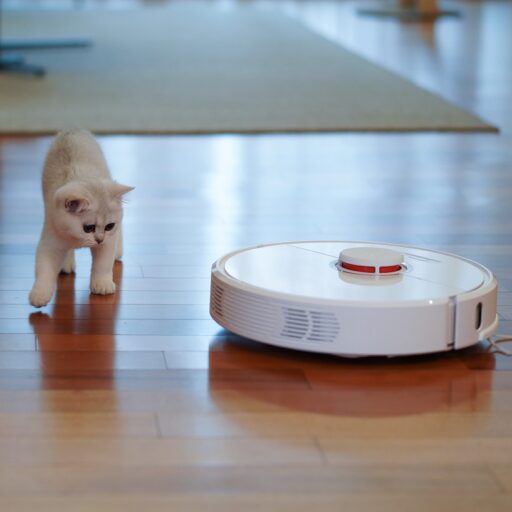
- Romba (iRobot): Uses SLAM (Simultaneous Localization and Mapping) to navigate your home, avoiding obstacles and returning to its dock.
- Roborock: Known for its advanced mapping and ability to mop and vacuum simultaneously.
The Lawn Mowers
- Husqvarna Automower: Uses GPS and boundary wires to mow your lawn autonomously.
- Gardena Sileno: A quieter, wire-free alternative using GPS.
The Humanoid Hype
This is where things get tricky.
- Unitree G1: A humanoid robot capable of complex movements, but currently more of a developer platform than a home appliance.
- UBTECH UWorld: Promising emotional support and companionship, but facing the Uncanny Valley challenge.
The Verdict: For specific tasks (vacuuming, mowing), yes. For general “cleaning the house” or “coking dinner,” we still have a long way to go. The complexity of a cluttered home is a nightmare for current AI.
👁️ AI, Video Analytics, and Privacy: The Thin Line Between Safety and Surveillance
Here’s where the party gets a little dark. The same technology that helps a robot navigate your living room can be used to watch you 24/7.
The Rise of “Robot Guards”
According to a recent ACLU report, the 50 million surveillance cameras in the US are evolving from passive recorders into active, AI-driven monitors.
- What they do: Analyze body language, detect “suspicious” behavior, and even estimate emotions.
- The Risk: As the ACLU warns, “It is as if a great surveillance machine has been growing up around us… and is now, in a meaningful sense, waking up.”
The Bias Problem
AI video analytics are not infallible.
- False Positives: Systems have been known to flag innocent people as threats based on race or clothing.
- Chilling Effect: Knowing you are being constantly analyzed can change how you behave, stifling free expression.
The “Emotion Recognition” Trap
Some systems claim to read your emotions to determine creditworthiness or security risk.
- Reality Check: There is little scientific consensus that facial expressions reliably map to internal emotional states. Relying on this for life-altering decisions is dangerous.
Question for you: Would you let a robot judge your “suspiciousness” based on how you walk? We’ll explore the legal implications of this in the next section.
⚖️ Ethical Dilemmas and Legal Hurdles in the Age of Autonomous Machines
If a robot makes a mistake, who is to blame? The manufacturer? The programmer? The owner? Or the robot itself?
The Liability Gap
Current laws are struggling to keep up with Autonomous Robots.
- Scenario: A delivery robot hits a pedestrian.
- The Dilemma: Is it a product defect, a software bug, or a user error?
The Trolley Problem in Real Life
Self-driving cars and robots face ethical choices.
- The Choice: If an accident is inevitable, should the robot swerve to hit a wall (risking the passenger) or continue straight (risking a pedestrian)?
- The Reality: These decisions are often pre-programed, raising questions about who gets to decide the value of human life.
Data Privacy
Robots collect massive amounts of data.
- Who owns it? The company that made the robot? The user?
- Security: If a robot is hacked, it could become a spy or a weapon.
For more on these critical issues, visit our Robot Ethics and Safety category.
🛡️ The Rise of AI-Powered Security: Why an Army of Robot Surveillance Guards Is Coming
The ACLU report highlights a disturbing trend: the deployment of AI-powered “robot guards” in public spaces.
Real-World Deployments
- NYPD & Microsoft: A partnership to upgrade over 6,0 cameras with AI analytics to predict crime before it happens.
- China’s Financial Sector: Using emotion recognition to assess credit risk.
- Retail: Stores using AI to detect shoplifters based on “fidgeting” or “restlessness.”
The Dystopian Scenarios
- Insurance: Companies monitoring your jogging speed to adjust life insurance premiums.
- Politics: Campaigns tracking rally attendees’ facial expressions to identify “enemies.”
- Minor Infractions: Corupt officials using AI to find political enemies jaywalking.
The Counter-Argument
Proponents argue that these tools can save lives by predicting violence and optimizing resource allocation. However, the ACLU warns: “When it comes to AI video analytics, we should be scared that it won’t work, and we should be scared that it will.”
📊 New Data Reveals Alarming Growth in AI Video Surveillance Technologies
The numbers are staggering. The market for AI video analytics is projected to grow exponentially in the next decade.
- Market Size: Expected to reach billions of dollars by 2030.
- Adoption Rate: Rapidly increasing in schools, airports, and public squares.
- Technology Mix: Combining Facial Recognition, Gait Analysis, and Emotion Detection.
The Data Gap
While the technology is advancing, the regulatory framework is laging.
- Transparency: Many deployments are opaque, with no public notice.
- Oversight: Lack of independent audits to check for bias or errors.
🔮 Future Trends: What’s Next for Human-Robot Collaboration?
So, where are we heading? The future isn’t about robots replacing humans; it’s about Human-Robot Collaboration.
The Rise of Cobots
Cobots are designed to work safely alongside humans, sharing tasks and learning from them.
- Example: A human asembles the delicate parts, while the robot handles the heavy lifting.
Emotional Intelligence
Future robots will need to understand human emotions to interact effectively.
- UBTECH’s Vision: Robots that can offer companionship and emotional support, especially for the elderly.
The “BrainNet” Concept
Imagine a network where robots share knowledge instantly. If one robot learns a new trick, they all learn it. This is the concept behind BrainNet 2.0.
The Uncanny Valley Challenge
As robots become more human-like, we must address the psychological discomfort they cause.
- Solution: Designing robots that are clearly mechanical but still expressive, avoiding the “almost human” trap.
🛠️ How to Choose the Right Robot AI for Your Business or Home
Ready to bring a robot into your life? Here’s a checklist to help you navigate the market.
1. Define Your Needs
- Task: What exactly do you want the robot to do? (Vacuum, lift, monitor?)
- Environment: Is it a cluttered home, a factory floor, or an outdoor field?
2. Check the Specs
- Sensors: Does it have LIDAR, cameras, or tactile sensors?
- Battery Life: How long can it run on a single charge?
- Payload: How much weight can it carry?
3. Evaluate the Software
- AI Capabilities: Can it learn and adapt?
- Connectivity: Does it integrate with your existing smart home system?
- Updates: Does the manufacturer provide regular software updates?
4. Consider Safety and Ethics
- Safety Features: Does it have emergency stop buttons and obstacle avoidance?
- Data Privacy: How is your data stored and used?
- Bias: Has the AI been tested for bias?
5. Budget and Support
- Cost: Remember, the price isn’t just the hardware; it’s the maintenance and software subscriptions.
- Support: Does the company offer good customer service and technical support?
👉 CHECK PRICE on:
- Unitree G1: Amazon | Unitree Official
- iRobot Romba: Amazon | iRobot Official
- Roborock: Amazon | Roborock Official
💡 Quick Tips and Facts (Revisited)
We mentioned these earlier, but let’s reinforce them with a bit more context from our engineering team.
- Maintenance is Key: Just like a car, robots need regular maintenance. Clean the sensors, check the batteries, and update the software.
- Don’t Overtrust: Even the smartest AI can make mistakes. Always have a human in the loop for critical decisions.
- Start Small: If you’re new to robotics, start with a simple task like vacuuming before investing in a humanoid.
- Community Matters: Join forums and communities to learn from other users and share tips.
Final Thought: We started this article wondering if robots could truly replace us. The answer is complex. They can replace tasks, but not humanity. The future is about collaboration, not replacement. But as we’ve seen with the rise of surveillance and the potential for bias, we must remain vigilant.
🏁 Conclusion

We’ve journeyed from the clunky arms of the past to the AI-driven wonders of today. Robot AI is no longer science fiction; it’s a reality that’s reshaping our world.
The Positives:
- Increased efficiency and productivity.
- Enhanced safety in hazardous environments.
- New opportunities for companionship and support.
The Negatives:
- Privacy concerns and surveillance risks.
- Potential for bias and discrimination.
- Ethical dilemmas regarding liability and decision-making.
Our Recommendation:
Embrace Robot AI with open eyes. Use it to enhance your life, but don’t let it replace your judgment. Stay informed, demand transparency, and advocate for ethical regulations. The future is bright, but only if we steer it in the right direction.
As we close the book on this topic, remember the words of the ACLU: “We should be scared that it won’t work, and we should be scared that it will.” Let’s make sure it works for us, not against us.
🔗 Recommended Links
Shopping for Robots
- Unitree G1: Amazon | Unitree Official
- iRobot Romba: Amazon | iRobot Official
- Roborock: Amazon | Roborock Official
- Boston Dynamics Spot: Boston Dynamics Official
Books on Robot AI
- “Life 3.0: Being Human in the Age of Artificial Intelligence” by Max Tegmark – Amazon
- “Human Compatible: Artificial Intelligence and the Problem of Control” by Stuart Russell – Amazon
- “The Age of Surveillance Capitalism” by Shoshana Zuboff – Amazon
❓ FAQ

What are the latest advancements in robot AI technology?
Recent advancements include multimodal learning (combining vision, sound, and touch), reinforcement learning for better decision-making, and edge computing for faster processing. Companies like UBTECH are pushing the boundaries with humanoid robots that can mimic human emotions.
Read more about “🤖 The Ultimate Robot News Roundup: 10 Breakthroughs Shaping 2026”
How will robot AI change the future of work?
Robot AI will likely automate repetitive and dangerous tasks, freeing humans to focus on creative and strategic work. However, it also raises concerns about job displacement and the need for reskilling.
Read more about “🐕 Spot Review: The Ultimate Robot Dog Boston Dynamics Guide (2026)”
Are there any ethical concerns with robot AI development?
Yes. Key concerns include bias in decision-making, privacy violations through surveillance, and the liability gap when robots cause harm. The ACLU and other organizations are calling for strict regulations to address these issues.
Read more about “🔮 10 Shocking Robot Predictions for 2026: What’s Real?”
What is the difference between traditional robots and AI-powered robots?
Traditional robots follow pre-programed instructions and cannot adapt to changes. AI-powered robots use machine learning to learn from data and adapt to new situations in real-time.
Read more about “🤖 Are Robot Manual Symbols Standardized? (2026)”
How can businesses integrate robot AI into their operations?
Businesses should start by identifying tasks that are repetitive, dangerous, or data-intensive. They can then choose robots that fit their specific needs, ensuring proper training and safety protocols are in place.
Read more about “Mastering Industrial Robot Instructions: The Ultimate Guide (2025) 🤖”
What are the most popular robot AI applications in 2024?
Popular applications include autonomous vehicles, warehouse automation, surgical robots, and companion robots for the elderly.
Read more about “🐕 How Much is the Chinese Robot Dog? (2026 Price Guide)”
Can robot AI learn and adapt without human intervention?
Yes, through unsupervised learning and reinforcement learning, robots can learn from their environment and improve their performance over time. However, human oversight is still crucial for safety and ethical reasons.
📚 Reference Links
- ACLU Report: The Dawn of Robot Surveillance
- Unitree G1 Specs: Unitree G1 Official Page
- The Guardian: AI can write just like me. Brace for the robot apocalypse
- Boston Dynamics: Spot Robot
- iRobot: Romba Series
- UBTECH: UWorld Robot Series
- Robot Instructions: Robot Instructions Home
- Robot Instructions: Agricultural Robotics
- Robot Instructions: Robot Design
- Robot Instructions: Machine Learning
- Robot Instructions: Robot Ethics and Safety
- Robot Instructions: Autonomous Robots