Support our educational content for free when you purchase through links on our site. Learn more
🤖 Robot Regulations 2026: The Ultimate Safety & Liability Guide

The bottom line is simple: there is no single global law for robots, so you must navigate a fragmented patchwork of safety standards, ethical guidelines, and liability rules that vary wildly by country and application. Understanding these Robot regulations isn’t just about avoiding fines; it’s the difference between a successful deployment and a catastrophic lawsuit.
Imagine building a high-tech cobot that passes every safety test in the US, only to have it seized at a European port because it lacks a specific “human-robot interaction” certification. We’ve seen it happen to startups who assumed “safe” meant the same thing everywhere.
The reality is stark: the EU AI Act treats robots as high-risk software, while the US OSHA focuses on physical guards and lockout procedures. If you ignore these nuances, your innovation could become your liability.
Key Takeaways
- Compliance is Fragmented: There is no “one-size-fits-all” rule; you must adhere to specific regional laws like the EU AI Act, US OSHA standards, and ISO 10218.
- Liability is Shifting: Manufacturers are increasingly facing strict liability for autonomous decisions, moving away from the old “operator error” defense.
- Safety Includes Cybersecurity: Modern regulations now mandate that hacking risks are treated as physical safety hazards, requiring robust threat assessments.
- Documentation is Your Defense: Detailed risk assessments and testing logs are your only shield against lawsuits when things go wrong.
Table of Contents
- ⚡️ Quick Tips and Facts
- 🤖 The Evolution of Robot Regulations: From Asimov to AI
- 🌍 Global Landscape of Robotics Policy and Compliance
- 🛡️ Safety Standards and Risk Management in Robotics
- ⚖️ Ethical Frameworks and Liability for Autonomous Systems
- 🏭 Industrial Robotics Regulations: OSHA, ISO, and Beyond
- 🏠 Consumer Robotics: Privacy, Data Security, and Home Safety
- 🚑 Medical and Healthcare Robotics: FDA Approval and Clinical Guidelines
- 🚗 Autonomous Vehicles: Navigating Traffic Laws and Testing Protocols
- 🤖 Human-Robot Interaction: Social Norms and Behavioral Guidelines
- 🔮 Future-Proofing: Emerging Trends in Robot Governance
- 💡 Quick Tips and Facts
- 🏁 Conclusion
- 🔗 Recommended Links
- ❓ FAQ
- 📚 Reference Links
⚡️ Quick Tips and Facts
Before we dive into the labyrinth of legal jargon and safety protocols, let’s get the lowdown on what actually matters when you’re dealing with robot regulations. Whether you’re a hobbyist building a custom arm in your garage or a CTO deploying a fleet of autonomous bots, these nugets are your lifeline.
- It’s Not Just About “Robots”: Did you know that regulations often depend on function, not form? A robotic vacuum is treated differently than a robotic surgical arm, even if they both have wheels and sensors.
- The “One-Time” Rule: According to the CPSC’s Regulatory Robot, you can’t just run a compliance check once for your whole company. As they state, “As most products are unique, each product may need to comply with different requirements so you’ll need to run the Robot one time for each product.” 🤖
- Safety is Baked In, Not Sprinkled On: The latest ISO 10218 updates emphasize that cybersecurity is now a physical safety issue. If a hacker can turn off your emergency stop, your robot is a ticking time bomb. 🔒
- The Asimov Myth: While Isaac Asimov’s Three Laws of Robotics are legendary in sci-fi, real-world robots do not come pre-programed with them. We have to build these ethical constraints from scratch, and often, we’re still figuring out how.
- Liability is a Gray Area: If a robot hurts someone, is it the manufacturer, the programer, or the owner? The answer changes depending on whether you’re in the EU, the US, or Japan.
For a deeper dive into how we approach these challenges at our lab, check out our guide on Robot Instructions.
🤖 The Evolution of Robot Regulations: From Asimov to AI
The Fictional Foundation
Let’s be honest: when we first started tinkering with servos and microcontrollers, we all had a secret hope that our creations would just “know” right from wrong. Enter Isaac Asimov. In his 1942 story Runaround, he introduced the Three Laws of Robotics, a set of rules that seemed like the perfect safety net:
- A robot may not injure a human being or, through inaction, allow a human being to come to harm.
- A robot must obey the orders given it by human beings except where such orders would conflict with the First Law.
- A robot must protect its own existence as long as such protection does not conflict with the First or Second Law.
Asimov later added the Zeroth Law to protect humanity as a whole, but here’s the kicker: these laws are fiction. They were designed to create plot holes for his stories, not to be coded into a PLC. As noted in the Wikipedia analysis of these laws, robots in Asimov’s universe often suffered “mental collapse” when faced with paradoxes. In the real world, we don’t have “positronic brains” that can collapse; we have code that crashes or, worse, executes exactly what it was told to do, even if it’s disastrous.
The Real-World Shift
Fast forward today, and the landscape has shifted from “how do we stop them from killing us?” to “how do we manage the chaos of autonomous decision-making?”
The UK’s EPSRC/AHRC working group (2010/201) was one of the first to try translating Asimov’s dreams into reality with five principles, including the idea that “Humans, not robots, are responsible agents.” This is a crucial distinction. Unlike the movies, where the robot takes the blame, the law generally points the finger at the human operator or the manufacturer.
Why the disconnect? As Roger Clarke argued, behavior cannot be reliably constrained by a simple set of rules. The complexity of the real world is too high. A robot might interpret “do not harm” as “do not move,” effectively becoming a paperweight, or it might decide that the only way to save a human is to perform a risky surgery without consent.
The Rise of the “Regulatory Robot”
In the US, the Consumer Product Safety Commission (CPSC) introduced a tool literally called the Regulatory Robot. It’s not a physical bot, but a digital wizard that guides small businesses through the Consumer Product Safety Improvement Act (CPSIA).
“Product safety and compliance are serious stuff,” the CPSC warns. “We hope that the Regulatory Robot is the beginning of your journey to manufacture products that are safe and compliant for American consumers.”
This tool highlights a massive gap in the industry: compliance is fragmented. You can’t just build a robot and ship it. You have to navigate a maze of federal, state, and international laws.
🌍 Global Landscape of Robotics Policy and Compliance
One size definitely does not fit all when it comes to robot regulations. What’s legal in Silicon Valley might get your shipment seized in Brussels or Tokyo. Let’s break down the major players.
🇪🇺 The European Union: The Ethical Heavyweight
The EU is currently leading the charge with the AI Act, which categorizes AI systems by risk.
- High-Risk Systems: Includes robots used in critical infrastructure, education, and law enforcement. These require strict conformity assessments, human oversight, and high-quality data.
- Transparency: Users must be informed when they are interacting with a machine.
- Liability: The EU is moving toward a strict liability framework for high-risk AI, meaning the operator or manufacturer could be held responsible without needing to prove negligence.
🇺🇸 The United States: The Sector-Specific Approach
The US prefers a sector-specific approach rather than a single overarching law.
- OSHA: Focuses heavily on industrial safety (more on this later).
- NIST: The National Institute of Standards and Technology provides frameworks for AI risk management but lacks the teeth of the EU’s AI Act.
- State Laws: States like California and Arizona are experimenting with their own rules for autonomous vehicles, creating a patchwork of regulations that manufacturers must navigate.
🇯🇵 Japan: The Friendly Robot Nation
Japan has a unique cultural relationship with robots, often viewing them as partners rather than tools.
- Robot Ethics Charter: Proposed in 207, this charter encourages developers to consider the social impact of robots.
- Focus: The emphasis is on human-robot collaboration and ensuring robots enhance the quality of life, rather than just preventing harm.
🇨🇳 China: The Speed Runner
China is aggressively pushing for domestic standards to support its manufacturing dominance.
- National Standards: China has been rapidly developing GB standards for service robots and industrial arms.
- Goal: To create a unified market that accelerates deployment while maintaining state control over data and security.
| Region | Primary Focus | Key Regulation/Standard | Liability Approach |
|---|---|---|---|
| EU | Ethics & Risk | AI Act, GDPR | Strict Liability (High Risk) |
| US | Safety & Innovation | OSHA, NIST Framework | Negligence-based (mostly) |
| Japan | Collaboration | Robot Ethics Charter | Shared/Manufacturer |
| China | Speed & Scale | GB Standards | State-Defined |
🛡️ Safety Standards and Risk Management in Robotics
Safety isn’t just a “nice to have”; it’s the foundation of any robot that interacts with humans. If you skip this step, you’re not just risking a lawsuit; you’re risking lives.
The ISO 10218 Standard: The Gold Standard
For industrial robots, ISO 10218 is the bible. It’s split into two parts:
- Part 1: Robot design and construction.
- Part 2: System integration and installation.
The 2025 Update: A Game Changer
The upcoming 2025 update to ISO 10218 introduces a risk-based classification system that changes how we think about robot size and power.
- Class I: Robots weighing 10 kg or less, with a max force of 50 N and speed of 250 mm/s. These are considered “low risk” and have relaxed safety requirements.
- Class II: Anything bigger or faster. These get the full treatment: rigorous testing, mandatory safety sensors, and strict operational limits.
Why does this matter? It means a small collaborative robot (cobot) from Universal Robots might not need a cage, but a heavy-duty KUKA arm definitely will.
The “Safety Net” of Stop Functions
Modern robots rely on a layered approach to stopping:
- Normal Stop: The robot finishes its task and powers down gracefully.
- Protective Stop: Triggered by a sensor (like a light curtain) when a human enters the workspace. The robot halts immediately but keeps power to memory.
- Emergency Stop (E-Stop): The big red button. Cuts power to motors instantly. This is your last line of defense.
Cybersecurity: The New Physical Safety
Here’s a scary thought: What if a hacker turns off your E-Stop?
The new regulations mandate that manufacturers must conduct threat assessments. If your robot can be remotely hijacked to injure someone, it fails the safety test. This is a massive shift from treating cybersecurity as an IT issue to treating it as a physical safety issue.
Step-by-Step Risk Management
- Identify Hazards: What can the robot do? (Pinch, crush, strike, electrocute).
- Estimate Risk: How likely is it to happen, and how bad would it be?
- Reduce Risk: Add guards, sensors, or software limits.
- Verify: Test the robot under worst-case scenarios.
- Document: Keep a log of every test. If it goes wrong, you need to prove you did your due diligence.
⚖️ Ethical Frameworks and Liability for Autonomous Systems
We’ve talked about safety, but what about ethics? When a robot makes a decision that harms someone, who is to blame?
The Liability Labyrinth
- Manufacturer Liability: If the robot has a design defect (e.g., the arm moves too fast for its sensors), the manufacturer is on the hook.
- Operator Liability: If the human ignored safety protocols or bypassed a guard, the operator is responsible.
- The “Black Box” Problem: With Machine Learning models, the robot might make a decision that even its programmers don’t understand. If the AI “hallucinates” a path that causes a crash, is it the fault of the algorithm or the data?
The IEEE’s “Three Laws of Responsible Robotics”
In 2019, Robin Murphy and David D. Woods proposed a modern update to Asimov’s laws:
- A human may not deploy a robot without the human-robot work system meeting the highest legal and professional standards of safety and ethics.
- A robot must respond to humans as appropriate for their roles.
- A robot must be endowed with sufficient situated autonomy to protect its own existence as long as such protection provides smooth transfer of control.
These aren’t laws, but they are becoming the industry standard for ethical design.
Real-World Case Studies
- The Uber Self-Driving Crash (2018): An Uber test vehicle struck and killed a pedestrian. The investigation revealed that the safety driver was distracted, but the software failed to classify the pedestrian correctly. The result? A massive settlement and a shift in how autonomous testing is regulated.
- Boston Dynamics’ Spot: While not involved in a major accident, Spot’s deployment in hazardous environments (like nuclear plants) raises questions about data privacy and surveillance.
The Big Question: Can we ever truly program conscience into a machine? Or do we just need better lawyers?
🏭 Industrial Robotics Regulations: OSHA, ISO, and Beyond
If you work in a factory, you know the drill: Safety First. But the rules are getting more complex as robots get smarter.
OSHA: The US Enforcer
The Occupational Safety and Health Administration (OSHA) doesn’t have a specific “Robotics Standard,” but they enforce general duty clauses.
- General Duty Clause: Employers must provide a workplace free from recognized hazards.
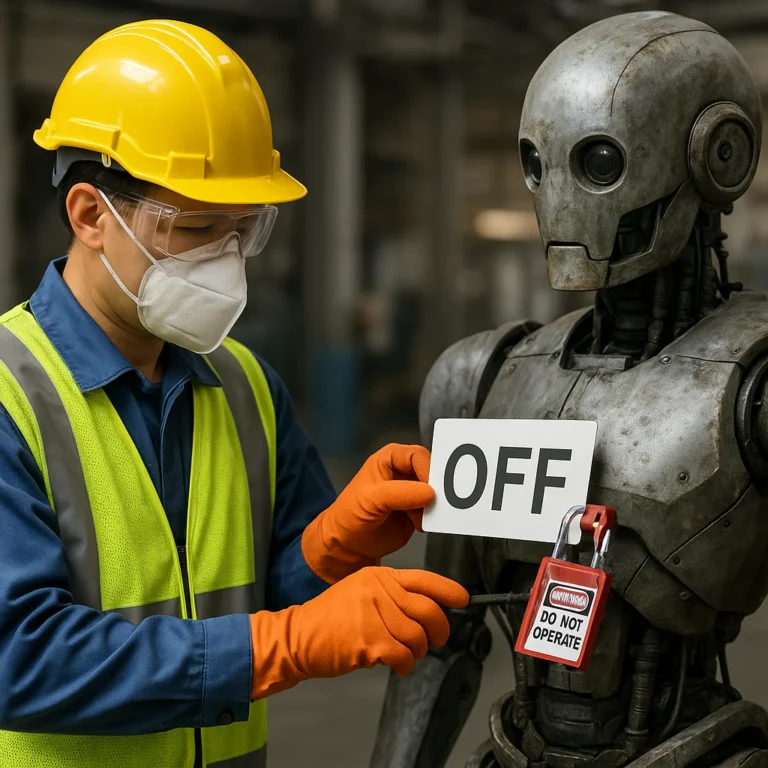
- Key Focus: Lockout/Tagout (LOTO) procedures are critical. If you’re working on a robot, you must ensure it can’t turn on.
- Collaborative Robots: OSHA has issued guidelines for cobots, emphasizing that even if a robot is “safe,” it still needs risk assessment.
ISO 10218 & TS 1506
- ISO 10218: As mentioned, this covers the robot itself.
- TS 1506: This technical specification focuses specifically on collaborative robots. It defines the power and force limits for human-robot contact.
Pain Threshold: The standard sets limits on how much force a robot can exert on a human before it’s considered “injurious.”
Skin Contact: If a robot hits a human, it must stop before causing pain.
The “Cage” is Going Away
Gone are the days of massive steel cages. Modern regulations allow for cage-free operation if:
- Speed and Separation Monitoring: The robot slows down as a human gets closer.
- Hand Guiding: The human can physically guide the robot arm.
- Power and Force Limiting: The robot is designed to be soft and compliant.
Pro Tip: Don’t assume your cobot is safe just because it’s a cobot. You still need to perform a risk assessment for your specific application.
🏠 Consumer Robotics: Privacy, Data Security, and Home Safety
You’ve probably got a robot vacuum or a smart home assistant. But have you ever wondered what data they’re collecting?
The Privacy Paradox
Consumer robots are essentially cameras and microphones on wheels.
- Data Collection: They map your home, record your conversations, and track your habits.
- Data Security: If a hacker gets into your iRobot Romba, they could see your floor plan. If they get into your Amazon Astro, they could watch you.
Key Regulations
- GDPR (EU): Requires explicit consent for data collection and the “right to be forgotten.”
- CCPA (California): Gives consumers the right to know what data is collected and to opt-out of sales.
- CPSIA (US): Ensures physical safety, especially for toys and products used by children.
Real-World Examples
- iRobot Romba: Has faced scrutiny over how it handles map data. They claim to anonymize data, but the details are often buried in Terms of Service.
- Amazon Astro: Designed as a home companion, it raises questions about surveillance and always-on listening.
What to look for: When buying a consumer robot, check the privacy policy. Does the company sell your data? Can you delete your map? Is the data encrypted?
🚑 Medical and Healthcare Robotics: FDA Approval and Clinical Guidelines
When robots enter the operating room, the stakes are life and death.
FDA Approval Process
In the US, medical robots are regulated by the Food and Drug Administration (FDA).
- Class III Devices: Most surgical robots fall into this category, requiring Premarket Approval (PMA). This is the most rigorous process, requiring clinical trials to prove safety and effectiveness.
- 510(k) Clearance: For devices that are “substantially equivalent” to existing ones, the process is faster but still strict.
Key Standards
- IEC 60601: The international standard for medical electrical equipment safety.
- ISO 13485: Quality management systems for medical devices.
The da Vinci Surgical System
The Intuitive Surgical da Vinci system is the most famous surgical robot. It has revolutionized minimally invasive surgery but has also faced lawsuits over mechanical failures and surgeon training.
- Training: Surgeons must undergo extensive training to operate these systems.
- Liability: If a robot malfunctions, the hospital and the manufacturer can both be sued.
The Future: As AI enters the operating room, the FDA is grappling with how to regulate adaptive algorithms that learn from surgery.
🚗 Autonomous Vehicles: Navigating Traffic Laws and Testing Protocols
Self-driving cars are the most visible form of robot regulation.
The Patchwork of Laws
- Federal: The NHTSA (National Highway Traffic Safety Administration) sets safety standards but has limited authority over software.
- State: States like California, Arizona, and Florida have their own testing permits and reporting requirements.
- International: The UNECE (United Nations Economic Commission for Europe) has been updating regulations to allow for Level 3 and Level 4 automation.
Testing Protocols
- Disengagement Reports: In California, companies must report how often a human had to take over.
- Safety Cases: Manufacturers must prove their system is safe before deploying.
The “Trolley Problem” in Real Life
How should a self-driving car react if it must choose between hitting a pedestrian or swerving into a wall?
- Ethical Algorithms: Researchers are trying to program these decisions, but there is no consensus.
- Liability: If the car makes a “bad” choice, who is responsible? The manufacturer, the software developer, or the passenger?
🤖 Human-Robot Interaction: Social Norms and Behavioral Guidelines
As robots become more social, we need rules for how they behave around us.
The Uncanny Valley
If a robot looks too human, it creps us out. Regulations are starting to address deception.
- Transparency: Robots must clearly indicate they are machines.
- Vulnerable Users: Special rules apply to robots interacting with children and the elderly.
Social Norms
- Eye Contact: Should a robot look you in the eye?
- Personal Space: How close can a robot get?
- Voice: Should a robot sound like a human or a machine?
The Challenge: These aren’t just technical issues; they’re cultural ones. What’s polite in Japan might be rude in the US.
🔮 Future-Proofing: Emerging Trends in Robot Governance
The future is fast, and the laws are playing catch-up.
The Rise of “Algorithmic Auditing”
Just as we audit financial statements, we will soon need to audit AI algorithms for bias and safety.
- Third-Party Audits: Independent bodies will verify that robots meet safety standards.
- Transparency: Companies may be required to publish their training data and decision logs.
The Global Harmonization Effort
There’s a push to create international standards to avoid a patchwork of conflicting laws.
- ISO/IEC JTC 1/SC 42: The committee working on AI standardization.
- OECD AI Principles: A set of guidelines adopted by many countries to promote trustworthy AI.
The “Right to Repair”
As robots get more complex, the Right to Repair movement is gaining traction.
- Access to Parts: Can you fix your own robot, or do you have to call the manufacturer?
- Software Locks: Manufacturers often lock software, preventing third-party repairs.
The Big Question: Will we see a global “Robot Constitution” that overrides national laws? Or will the world remain a patchwork of conflicting regulations?
💡 Quick Tips and Facts (Revisited)
Let’s recap the most critical takeaways before we wrap up:
- Compliance is Continuous: It’s not a one-time check. Regulations evolve, and so must your robots.
- Safety is Holistic: It includes physical safety, cybersecurity, and ethical behavior.
- Liability is Shared: Manufacturers, operators, and even users share the burden.
- Global Differences Matter: Don’t assume a robot safe in the US is safe in the EU.
- Documentation is Key: If you didn’t write it down, it didn’t happen.
For more insights on specific robot categories, check out our articles on Agricultural Robotics, Machine Learning, Robot Design, Autonomous Robots, and Robot Ethics and Safety.
🏁 Conclusion

So, where does that leave us? The world of robot regulations is a complex, ever-shifting landscape. From Asimov’s fictional laws to the gritty reality of ISO 10218 and the EU AI Act, one thing is clear: safety and ethics are no longer optional.
We started this journey wondering if robots would ever “know” right from wrong. The answer is no—they won’t know. But we must know. We must build them with safety in mind, design them with ethics in place, and regulate them with foresight.
Our Recommendation:
Whether you’re a hobbyist or a Fortune 50 company, do not skip the risk assessment.
- For Manufacturers: Invest in cybersecurity and transparency. It’s not just about avoiding lawsuits; it’s about building trust.
- For Operators: Stay updated on local regulations and training requirements. Ignorance is not a defense.
- For Consumers: Read the privacy policies. Know what you’re bringing into your home.
The future of robotics is bright, but it’s up to us to make sure it’s safe and ethical. As we move forward, let’s remember that the best robot is the one that helps us, not harms us.
🔗 Recommended Links
Must-Have Resources
- The Three Laws of Robotics (Wikipedia): Read the full history and variations
- CPSC Regulatory Robot: Check compliance for your product
- ISO 10218 Standards: Buy the official standard
- NIST AI Risk Management Framework: Download the framework
Books for Deep Dives
- “I, Robot” by Isaac Asimov: Available on Amazon
- “The Ethics of Artificial Intelligence” by Nick Bostrom: Available on Amazon
- “Robots and Empire” by Isaac Asimov: Available on Amazon
Brands to Watch
- Universal Robots: Official Website
- Intuitive Surgical: Official Website
- Boston Dynamics: Official Website
- iRobot: Official Website
❓ FAQ

What are the current robot regulations in the European Union?
The EU is currently implementing the AI Act, which categorizes AI systems by risk level. High-risk systems, including many industrial and service robots, must undergo strict conformity assessments, ensure human oversight, and maintain high data quality. Additionally, the GDPR governs data privacy for robots that collect personal information.
How do robot laws differ between the US and Asia?
The US generally uses a sector-specific approach, relying on agencies like OSHA for safety and the FDA for medical devices, with a focus on innovation and liability based on negligence. In contrast, Japan emphasizes human-robot collaboration and has a “Robot Ethics Charter” that encourages social responsibility. China is rapidly developing national standards to support its manufacturing dominance, often prioritizing speed and scale.
Will AI robots be required to have liability insurance?
It’s highly likely. As robots become more autonomous, the EU and other jurisdictions are moving toward strict liability frameworks, which may require manufacturers or operators to carry liability insurance to cover potential damages. This is already a requirement for some autonomous vehicle testing programs.
What ethical guidelines govern the use of service robots?
While there is no single global law, guidelines like the IEEE’s “Three Laws of Responsible Robotics” and the EU’s Ethics Guidelines for Trustworthy AI provide frameworks. These emphasize transparency, human agency, privacy, and fairness. Service robots must not deceive users and should respect human dignity.
Read more about “🤖 150 Best Sci-Fi Robot Movies Ranked: The Ultimate Guide (2026)”
Are there specific regulations for autonomous delivery robots?
Yes. In the US, states like California and Arizona have specific permits for testing and operating autonomous delivery robots. These often require safety drivers, reporting of disengagements, and compliance with local traffic laws. The NHTSA is also developing federal guidelines for low-speed autonomous vehicles.
Read more about “🤖 Robot AI: The Real Future of Human-Robot Collaboration (2026)”
How do robot regulations impact the development of humanoid robots?
Regulations are pushing developers to prioritize safety and transparency. Humanoid robots, which interact closely with humans, face stricter risk assessments and ethical guidelines. The ISO 13482 standard specifically addresses personal care robots, ensuring they are safe for use in homes and care facilities.
Read more about “🤖 The Ultimate Robot News Roundup: 10 Breakthroughs Shaping 2026”
What legal responsibilities do robot manufacturers face under new laws?
Manufacturers are increasingly held responsible for design defects, cybersecurity vulnerabilities, and failure to warn. Under the EU AI Act, they must ensure their systems are compliant with safety and ethical standards. In the US, they face product liability lawsuits if their robots cause harm due to negligence or defect.
What is the “Zeroth Law” and does it apply to real robots?
The Zeroth Law (“A robot may not harm humanity…”) is a fictional addition by Asimov to address scenarios where a robot must harm an individual to save humanity. Real-world robots do not have this law programmed. In fact, programming such a concept is incredibly dangerous, as it could justify extreme actions against individuals in the name of the “greater good.”
Can a robot be held criminally liable?
Currently, no. Robots are considered property or tools, not legal persons. Criminal liability falls on the human operators, manufacturers, or owners who programmed, deployed, or maintained the robot. However, as AI becomes more autonomous, legal scholars are debating whether a new category of “electronic personhood” might be necessary in the future.
📚 Reference Links
- Occupational Safety and Health Administration (OSHA): Robotics – Standards
- Consumer Product Safety Commission (CPSC): Regulatory Robot
- International Organization for Standardization (ISO): ISO 10218
- European Commission: AI Act
- National Institute of Standards and Technology (NIST): AI Risk Management Framework
- IEEE: Ethically Aligned Design
- Wikipedia: Three Laws of Robotics
- Intuitive Surgical: da Vinci Systems
- Universal Robots: Cobots
- Boston Dynamics: Spot